

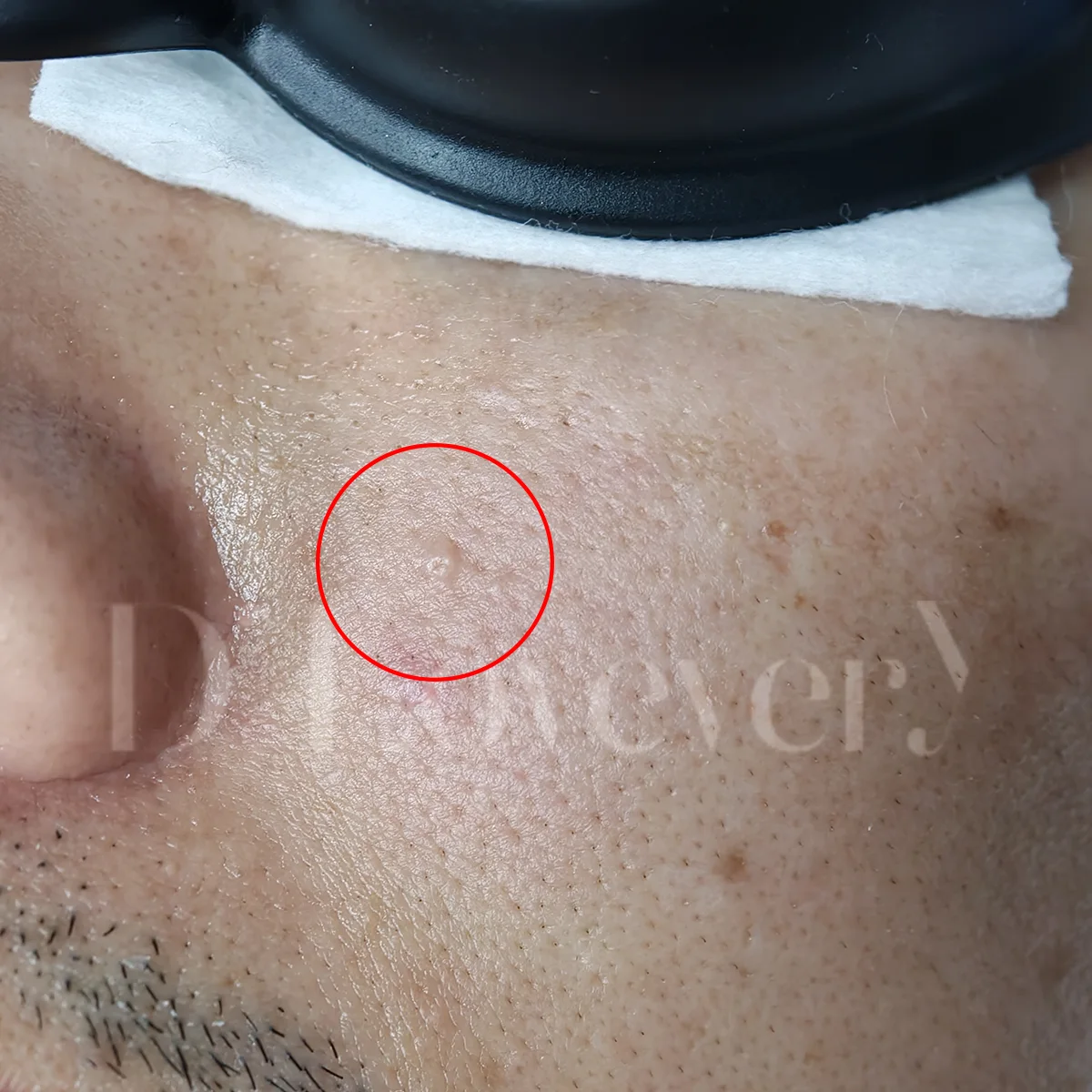
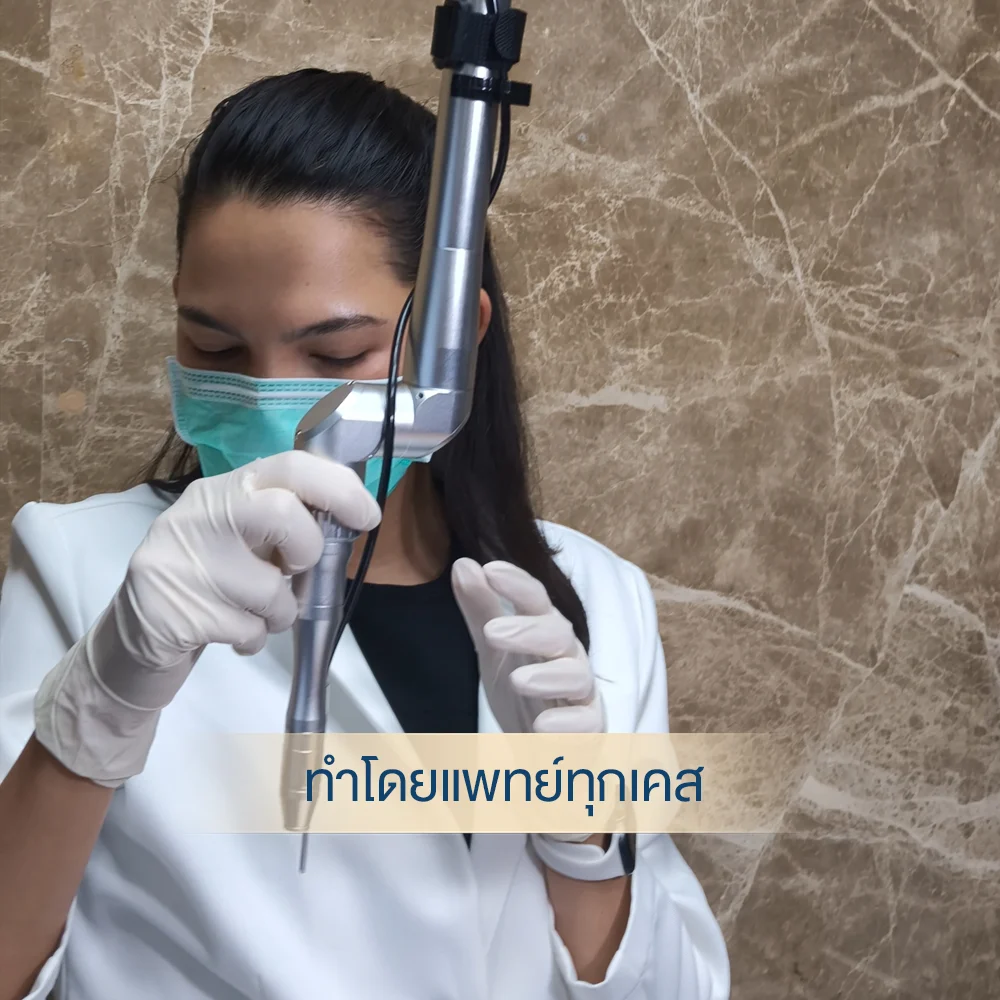
The doctor will explain that CO2 lasers work using wavelengths. 10,600 nanometers This substance is best absorbed by water in skin cells, allowing for precise evaporation of the tissue covering the pimple at the micron level—it's incredibly accurate.
Many people mistakenly believe that every pimple can be removed with a laser, but that's not true. CO2 Laser It's not suitable for all types of acne. I'll explain clearly which types of acne I'd recommend cauterization when you come to the clinic.
1. Closed comedones, also known as whiteheads.
This is the star of the show! The patient has previously experienced this problem. "When I touch my face, I feel a raised, hard bump, but I can't squeeze it out." Right? That's a closed comedone (a type of acne).
- Why would someone try to hijack something? Because these pimples "have no open pore," if the patient tries to squeeze them, the skin will bruise, become inflamed, and leave deep, dark scars.
- How lasers work: The doctor will use a CO2 laser to create a small "opening" in the pimple (like popping a water balloon) to make it easier to squeeze out the clogged sebum with minimal damage to surrounding tissue.
2. Milia (Skin growths)
This isn't actually real acne, but patients often call it acne. It's easy to spot because it's... Small, hard, cloudy white bumps often appear around the eyes or cheekbones. No matter how much acne cream I apply, the pimples won't go away.
- Why would someone try to hijack something? Because it's a keratin cyst embedded under the skin, medication won't work. The only way to completely cure it is to use laser heat to "open the skin" and remove these hard cysts.
3. Sebaceous Gland Hyperplasia
Patients in their 30s and older are starting to see this more often. It looks similar to acne, but it's... Yellowish-white bumps that often have a central indentation, resembling a donut.
- Why would someone try to hijack something? It's a condition of sebaceous gland dysfunction, not a bacterial infection. Acne creams won't help. You need a CO2 laser in a deeper penetration mode to remove excess skin and smooth the skin's surface.
4. Deep and stubborn clogged pores.
Sometimes, for very deep-seated clogged pores, regular squeezing can require too much force, causing pain, tears, and bruising. In such cases, the doctor will use a laser to create a pathway first, reducing the pressure. Helps reduce the chance of bruising and redness after squeezing pimples. Very good.
Imagine a closed comedone like... "A person is locked in a room without a door." Yes, applying ointment is like shouting through a wall (slow results). Squeezing it yourself is like hammering a wall (house/face destroyed). But using... A CO2 laser is like drilling a hole in the door for him to walk out peacefully. No, the house didn't get damaged and my skin isn't bruised.
![[Acne Treatment Review] Hormonal acne or mask-induced acne? Solve all problems with effective results and no recurring issues, because the doctor wants everyone to recover.](https://dloveveryclinic.com/storage/2025/11/case-128-d-acne-size-L-dlovevery-clinic-8.webp)
![[Acne Scar Removal Review] I used to have clear skin, but then a severe acne breakout left me feeling discouraged. This review shows how I rescued my damaged skin and got it back to its best with 3 programs from Dr. Tar.D' Lovevery Clinic](https://dloveveryclinic.com/storage/2025/11/case-127-meso-program-dlovevery-2.webp)
![[Acne Treatment Review] "Milia" attack! Clear it up with D' Facial's complete treatment formula. A must-try for sensitive skin!](https://dloveveryclinic.com/storage/2025/11/case-126-d-facial-treatment-before-after-1.webp)